
The enactment of Regulation of the Minister of Law of the Republic of Indonesia Number 49 of 2025 concerning the Requirements and Procedures for the Establishment, Amendment, and Dissolution of Limited Liability Companies (“Permenkum Number 49 of 2025”) marks an important change in the administrative regulations of Limited Liability Companies (PT). This regulation introduces new administrative obligations, particularly regarding annual reporting for joint stock companies and financial reporting for sole proprietorships. The question is: is this merely a strengthening of governance, or is it a form of overregulation that exceeds the mandate of the law?
Substantial Changes in Administrative Obligations
Prior to Minister of Law Regulation Number 49 of 2025, based on Law Number 40 of 2007 concerning Limited Liability Companies as last amended by Law Number 6 of 2023, the Board of Directors’ annual report was an internal obligation submitted to the GMS (Article 66). The Limited Liability Company Law positions the annual report as: An instrument of accountability of the Board of Directors to the GMS; A forum for evaluation by shareholders; and the basis for granting discharge of liability (acquit et de charge).
Minister of Law Regulation Number 49 of 2025 shifts this paradigm by:
| Aspects
|
Regular Limited Liability Company | Individual Limited Liability Company |
| Administrative Obligations
|
“Annual Report” containing:
a. financial statements consisting of at least the balance sheet for the most recent fiscal year in comparison with the previous fiscal year, the income statement for the fiscal year in question, the cash flow statement, and the statement of changes in equity, as well as notes to the financial statements; b. a report on the Company’s activities; c. a report on the implementation of social and environmental responsibilities; d. details of issues that arose during the fiscal year that affected the Company’s business activities; e. a report on the supervisory duties performed by the board of commissioners during the past fiscal year; f. the names of the members of the board of directors and the board of commissioners; g. the salaries and allowances for members of the board of directors and the salaries or honoraria and allowances for members of the board of commissioners of the joint stock company for the past year. (Article 16 paragraph (6)) |
“Financial Report” containing:
a. statement of financial position; b. income statement; and c. notes to the financial statements for the current year. (Article 27 paragraph (2))
|
| Reporting Period
|
The Board of Directors shall submit the annual report to the GMS no later than 6 (six) months after the end of the Company’s fiscal year, and the notary shall submit it to the Minister within a maximum period of 30 (thirty) days from the date the notarial deed is signed.
(Article 16 paragraphs (1) and (3)) |
Submission of reports no later than 6 (six) months after the end of the current accounting period. (Article 27 paragraph (1))
|
| Report format
|
The annual report is recorded in a notarial deed and submitted through SABH (Article 16 paragraphs (2) and (5)).
|
Electronic financial reporting through SABH
(Article 27 paragraphs (1) and (4)). |
| Forms of administrative sanctions
|
a. Written warning; and
b. Access blocking; (Article 17 paragraph (2))
|
a. Written warning;
b. Termination of access rights to services; or c. Revocation of legal entity status (Article 28 paragraph (1)). |
This change is not merely technical, but rather a change in character. Annual reports are no longer just an internal corporate governance mechanism, but have become an administrative obligation that is directly supervised by the state.
Hierarchy Test: Is There an Expansion of Norms?
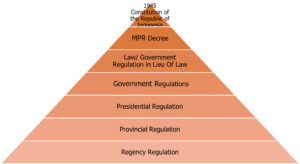
In the Indonesian legal system, the principle of lex superior derogat legi inferiori requires that regulations below the law may not add to or change the substance of norms established by law. The hierarchy of legislation is the foundation of the Indonesian legal system, designed to prevent conflicts between regulations and ensure that lower regulations do not exceed the limits set by higher regulations. This concept is reflected in Article 7 paragraph (1) of Law Number 12 of 2011 concerning the Formation of Legislation (“Law Number 12 of 2011”), which establishes the following hierarchy:
The PT Law does not regulate administrative sanctions that could even result in restricted access to the Legal Entity Administration System (“SABH”) and revocation of legal entity status. The dissolution of a company is limited based on Article 142 paragraph (1) of the PT Law, which requires dissolution through a GMS decision, a court ruling, the expiration of the term based on the articles of association, a commercial court ruling, or the revocation of a business license by a certain authority, and not automatically revoking legal entity status.
Here, it is necessary to distinguish between:
- Regular Limited Liability Company
The PT Law does not require the submission of annual reports to the Minister. This obligation is internal to the GMS. Thus, the obligation of external reporting accompanied by administrative sanctions can be viewed as an extension of the norm. If restrictions on access to SABH hinder the legal rights of the company (e.g., amendments to the articles of association, corporate actions, or strategic transactions), then the impact is no longer technical and administrative in nature, but rather touches on the rights of legal entities. It is at this point that the potential for vertical disharmony arises.
- Individual Limited Liability Company
For individual limited liability company, the obligation to submit annual financial reports and administrative sanctions are actually regulated in Government Regulation No. 8 of 2021. Thus, Minister of Law Regulation Number 49 of 2025 in this context serves to implement government regulations. However, the issue shifts to the proportionality of sanctions, particularly the revocation of legal entity status for administrative violations.
Risks of Overregulation in Corporate Governance
Ministerial regulations, such as Minister of Law Regulation Number 49 of 2025, are recognized as existing and have binding legal force as long as they are mandated by higher laws and regulations or based on the authority as stipulated in Article 8 paragraph (1) of Law Number 12 of 2011. Based on Law Number 12 of 2011 as amended several times, most recently Law Number 13 of 2022 concerning the Second Amendment to Law Number 12 of 2011 concerning the Formation of Legislation in the Explanation of Article 8 paragraph (1) states that ministerial regulations are regulations established by ministers based on the content in the context of administering government affairs in certain fields. This means that Ministerial Regulations may not create new substance that conflicts with higher-level regulations, but must implement existing provisions. In the event of a conflict, the higher regulation supersedes the lower one (lex superior derogat legi inferiori). In this case, if Minister of Law Regulation Number 49 of 2025 exceeds the PT Law Jo. Job Creation Law, it can be overridden and referred to the PT Law Jo. Job Creation Law.
Overregulation in the context of corporate law is not measured by the number of regulations, but rather by:
- The addition of procedural layers that do not change the substance of responsibility;
- Administrative intervention in private corporate mechanisms;
- Increased compliance costs without strengthening substantive accountability.
If annual reports continue to be approved by the GMS, and the responsibilities of the Board of Directors continue to be determined by the Limited Liability Company Law, then the additional reporting obligation to the Minister serves as an additional administrative layer, not as a new accountability mechanism.
Corporate law should ideally create:
- Legal certainty;
- Transaction efficiency;
- Predictability of procedures;
- Internal autonomy of corporate organs.
When the corporate annual cycle must always be linked to the state administrative system, the balance between oversight and autonomy shifts. The question is no longer one of legality, but rather: Is this design consistent with the direction of corporate law modernization that promotes simplification and efficiency?
Conclusion
Minister of Law Regulation Number 49 of 2025 brings real changes to the landscape of corporate administration. However, these changes also shift the character of GMS and annual reports from private mechanisms to state administrative instruments. In the context of corporate law reform, the addition of administrative layers needs to be reviewed within the framework of the overall design of the corporate legal system. Effective corporate regulation should not only be capable of oversight, but also capable of maintaining a balance between state control and corporate autonomy.
References:
Law Number 40 of 2007 concerning Limited Liability Companies in conjunction with Law Number 6 of 2023 concerning the Stipulation of Government Regulation in Lieu of Law Number 2 of 2022 concerning Job Creation into Law.
Government Regulation Number 8 of 2021 concerning the Authorized Capital of Companies and the Registration of the Establishment, Change, and Dissolution of Companies that Meet the Criteria for Micro and Small Businesses.
Law Number 12 of 2011 concerning the Formation of Legislation in conjunction with Law Number 15 of 2019 concerning Amendments to Law Number 12 of 2011 concerning the Formation of Legislation in conjunction with Law Number 13 of 2022 concerning the Second Amendment to Law Number 12 of 2011 concerning the Formation of Legislation
Minister of Law of the Republic of Indonesia Number 49 of 2025 concerning the Requirements and Procedures for the Establishment, Amendment, and Dissolution of Limited Liability Companies.
Author: Lasta Elfrida Sinaga, S.H.
Editor: Yohana Maranatha, S.H., M.Kn.