
- Land Registration as the State’s Obligation to Provide Legal Certainty
Article 19 paragraph (1) of Law Number 5 of 1960 concerning Basic Agrarian Principles (“UUPA”) requires the Government to conduct land registration throughout the territory of the Republic of Indonesia, with the purpose of providing legal certainty to holders of land rights. Land registration results in the issuance of a certificate of title that serves as strong evidence of such right.
These provisions are implemented through Government Regulation Number 24 of 1997 concerning Land Registration, as last amended by Government Regulation Number 18 of 2021. Land registration provides the basis for the State to record the physical and juridical data of a parcel of land and to issue a certificate as evidence of title.
The Constitutional Court, in the Minutes of Hearing of Case Number 64/PUU-XXIV/2026 dated 19 May 2026, recorded the statements of the Government and the House of Representatives of the Republic of Indonesia that land registration provides legal certainty and legal protection over land rights. Therefore, land registration constitutes an important instrument for establishing certainty regarding the status and holder of land rights.
- SHM Constitutes Strong Evidence, Not Conclusive Evidence
Article 32 paragraph (1) of Government Regulation No. 24 of 1997 stipulates that a certificate constitutes a document evidencing a right and serves as strong evidence of the physical and juridical data contained therein, provided that such data are consistent with the data in the survey document and land book.
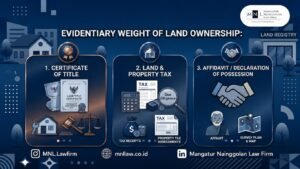
A Certificate of Ownership (Sertifikat Hak Milik or “SHM”) provides strong evidentiary value to the holder of the right. However, Indonesian land law does not regard an SHM as conclusive evidence. Such evidentiary value remains subject to challenge through evidence demonstrating that the physical or juridical data contained in the certificate do not correspond to the actual legal circumstances.
Accordingly, a party seeking to challenge an SHM must present the legal basis of its claim and relevant evidence to establish any inconsistency in the data, defects in the process of issuing the certificate, or a stronger legal basis to the land.
- SHM Must Be Examined Together with the Basis for Acquisition of the Right
An SHM cannot be separated from the history of acquisition of the land right. The certificate indicates the registered status of the right, whereas the underlying acquisition documents establish how the right was acquired.
Where Hak Milik is acquired through a sale and purchase, the Sale and Purchase Deed (Akta Jual Beli or “AJB”) executed by a Land Deed Official (Pejabat Pembuat Akta Tanah or “PPAT”) constitutes an important document in the process of transferring the right. The AJB evidences the legal act of sale and purchase that serves as the basis for registration of the transfer of the right.
Article 37 paragraph (1) of Government Regulation Number 24 of 1997 provides that the transfer of land rights through sale and purchase, exchange, grant, contribution to a company, and other legal acts involving the transfer of rights may only be registered if evidenced by a deed executed by an authorized PPAT.
Accordingly, in a registered land sale and purchase, the PPAT AJB serves as evidence of the legal act underlying the acquisition or transfer of the right, while the SHM indicates the registered status of Hak Milik in the name of the right holder.
The two documents have different functions. The AJB concerns the basis for the acquisition or transfer of the right, while the SHM concerns the registered status of the right. Therefore, when a dispute arises regarding the validity of the acquisition of a right, an examination should not be limited to the certificate. The court may examine the documents and legal events underlying the issuance or transfer of the certificate.
This assessment is consistent with the principle of land registration, which requires juridical data concerning land rights and their transfers to be recorded in the land administration system.
- PBB and Statement Letters Do Not Automatically Establish Ownership
Evidence of payment of Land and Building Tax (Pajak Bumi Bangunan or “PBB”) must be distinguished from evidence of land ownership. PBB constitutes a tax obligation relating to a taxable object. Payment of PBB does not, by itself, establish that a person is the holder of Hak Milik over the land.
PBB may nevertheless be submitted as evidence in civil proceedings. Evidence of PBB payment may demonstrate a person’s relationship with the taxable object or the payment of tax obligations, but it does not automatically establish the creation or registration of Hak Milik.
The same applies to a statement letter made personally or under private hand. Such a statement may constitute one form of evidence in civil proceedings, but it does not automatically override an SHM issued by the Land Office.
The evidentiary value of a statement letter must be assessed based on the identity of its maker, the date on which it was made, the basis for making the statement, its contents, and whether other supporting evidence exists.
Therefore, where a person relies solely on PBB payment evidence and a statement letter to challenge an SHM, both forms of evidence must be examined together with the certificate, land book, survey document, deed of transfer, and other documents forming the basis for the issuance of the certificate.
This principle is relevant to Supreme Court Decision Number 92 K/Pdt/2024 dated 21 February 2024, which held that a party holding an SHM and a PPAT AJB has a stronger evidentiary basis than a party whose claim is based solely on a statement letter and evidence of tax payments.
- Conclusion
In a land ownership dispute, the legal position of the parties cannot be determined solely based on physical possession, PBB payments, or statement letters. An SHM constitutes strong evidence of a registered right, while a PPAT AJB evidences the legal act underlying the transfer of the right. PBB and statement letters may constitute supporting evidence, but they do not, by themselves, override an SHM. Therefore, the assessment of land ownership must consider the status of the right, the basis and history of its acquisition, the physical and juridical data, and the validity of the documents underlying the issuance or transfer of the right.
Mangatur Nainggolan Law Firm (“MNL”) is ready to assist individuals and business entities in resolving land-related legal matters, conducting examinations of the history of land rights acquisition, land sale and purchase transactions, and handling land disputes. For further inquiries or legal services relating to land ownership and transactions, MNL is ready to provide legal assistance and solutions tailored to your legal needs and interests.
References:
Law Number 5 of 1960 concerning Basic Agrarian Principles.
Government Regulation Number 24 of 1997 concerning Land Registration, as last amended by Government Regulation Number 18 of 2021 concerning Management Rights, Land Rights, Apartment Units, and Land Registration.
Minutes of Hearing of the Constitutional Court Case Number 64/PUU-XXIV/2026, 19 May 2026.
Supreme Court of the Republic of Indonesia Decision Number 92 K/Pdt/2024, dated 21 February 2024.
Author: Lasta Elfrida Sinaga, S.H.
Editor: Robby Simamora, S.H.,M.H.