
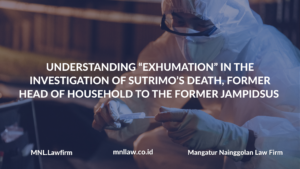
The investigation into the death of Sutrimo, former head of household to the Deputy Attorney General for Special Crimes (Jampidsus), Febrie Adriansyah, has brought the term “exhumation” to public attention. Approximately 20 (twenty) days after his burial, Sutrimo’s body was exhumed by investigators from the Jakarta Metropolitan Police (Polda Metro Jaya), together with a team of forensic doctors from PDFMI (Persatuan Dokter Forensik-Medikolegal Indonesia), on 12 August 2026 at the Wlahar Village Cemetery, Wangon District, Banyumas Regency. The exhumation was conducted to allow further examination of the body and to assist in determining the cause of death as part of the investigation.
However, what does “exhumation” mean in the context of criminal evidence?
Exhumation is the process of recovering a body that has already been buried for further forensic examination. It is generally carried out to identify the cause of death and/or to examine circumstances where questions or irregularities concerning a person’s death arise after the burial. The term “exhumation” comes from the Latin words “ex,” meaning “out,” and “humus,” meaning “earth” or “soil.” In forensic medicine terms, exhumation refers to a post-mortem examination of human remains to help establish the cause of death where it was previously unclear from a legal or medical perspective. In criminal law, this examination may form an important part of the investigation and evidentiary process. Therefore, exhumation must be carried out carefully and properly to preserve the integrity of the evidence and ensure that the examination results can be relied upon and accounted for in legal proceedings.
Is Exhumation Regulated by Law?
Under Indonesian criminal procedural law, exhumation for judicial purposes is regulated under Article 51 of Law Number 20 of 2025 concerning the Criminal Procedure Code (KUHAP), which provides:
“In the event that, for the purposes of judicial proceedings, an Investigator needs to exhume a body, such purpose shall be carried out in accordance with the provisions as referred to in Article 49 paragraph (2) and Article 50 paragraph (1).”
Article 51 refers to Article 49 paragraph (2) of the KUHAP, which regulates the Investigator’s authority to request an expert examination. Article 49 provides:
“(1) Where, for the purposes of judicial proceedings, an Investigator handles a victim who is injured, poisoned, or deceased and is suspected to have suffered such condition as a result of a criminal offense, the Investigator shall be authorized to request an expert opinion from a forensic medical expert or doctor and/or other experts.
(2) A request for an Expert Opinion as referred to in paragraph (1) shall be made in writing and shall clearly state that the examination concerns an injury, poisoning, a corpse, and/or an autopsy.”
Furthermore, Article 50 paragraph (1) of the KUHAP regulates the Investigator’s obligation to notify the victim’s family where an autopsy is required for evidentiary purposes. Article 50 provides:
“(1) Where, for evidentiary purposes, an autopsy is required and can no longer be avoided, the Investigator shall first notify the Victim’s Family of such autopsy.
(2) Where the Victim’s Family objects, the Investigator shall clearly explain the purpose and objective of the autopsy to the Victim’s Family.”
In addition to having a legal basis, exhumation is not carried out without a specific reason. In practice, exhumation is conducted where there is a need to obtain or confirm findings relating to the cause and circumstances of death. As a final step in forensic examination, exhumation may be carried out where the following criteria or indications are present:
- The defendant admits to having killed and/or buried the victim at a particular location;
- A suspicion arises that the cause of death was unnatural after the body has been buried for several days;
- A judge orders a re-examination of the body after it has previously been examined by a doctor for the preparation of a Visum et Repertum;
- The burial of the body is suspected to have been carried out legally but for the purpose of concealing the death or for criminal reasons;
- The death certificate states that the cause of death is “unclear,” giving rise to possible causes such as poisoning or suicide by hanging; or
- In a criminal case, the cause of death remains uncertain, such as where a homicide has been staged to appear as a suicide.
In the case of Sutrimo’s death, the exhumation was conducted after his family reported an alleged murder and/or premeditated murder under Police Report Number: STTLP/79/VIII/2026/SPKT/POLRESTA BANYUMAS/POLDA JAWA TENGAH, dated 8 August 2026. The report was made following various reports and uncertainty regarding the circumstances of Sutrimo’s death, which were later linked to the case involving former Jampidsus Febrie Adriansyah.
The exhumation process consists of 3 (three) stages, as follows:
- Preparation for the Exhumation
The preparation stage begins with a formal request for an examination of the body for the purpose of obtaining a Visum et Repertum, together with the required administrative documents and verification of the identity of the grave. These requirements include, but are not limited to, consent from the family to confirm that there is no objection to the exhumation.
A statement confirming the identity of the grave is also required and must be verified by the family, cemetery caretaker, and/or witnesses who can confirm that the grave belongs to the relevant person. For investigation purposes, the grave to be examined must remain under the supervision of the Investigator throughout the handling of the evidence.
- Conduct of the Exhumation
Once all pre-exhumation procedures and administrative requirements have been completed, the grave is opened with the involvement of forensic doctors, investigators, local community leaders or representatives, cemetery personnel, and the grave digger.
The excavation is carried out gradually and documented in chronological order. The documentation includes the condition of the grave before excavation, the identity of the grave marker, the location of the grave, the depth of the excavation, the condition of the soil, and the condition of the body when it is found. The position of the body, the burial shroud, and any objects found inside the grave are also recorded as part of the examination.
The most important part of the exhumation process begins after the body has been recovered. The forensic medical team and investigators then conduct a direct examination or autopsy, either at the burial site or at a hospital, depending on the circumstances and the examination required.
Where the autopsy is conducted directly at the cemetery or public cemetery, this may be done for reasons of efficiency, particularly where transportation is difficult or access to the location is limited, as well as to avoid possible misunderstanding among members of the public.
However, where the examination needs to be conducted at a hospital because it requires more detailed procedures and appropriate equipment, additional examinations may be carried out, including histopathological examination, which involves the microscopic examination of body tissue to identify changes or tissue damage, and toxicological examination, which is used to detect drugs, alcohol, poison, or other chemical substances in the body.
In such circumstances, the body must be transported to the hospital in accordance with strict procedures. The body must be properly wrapped and sealed, and its condition must be documented as evidence. The transportation of the body must also be accompanied by an official handover report.
- Handover to the Investigator
The final stage of the exhumation process takes place after the examination of the body has been completed and the body is handed over to the Investigator.
Afterwards, an official report on the reburial is prepared, together with a report on the handover of the grave back to the family. The body may then be reburied in accordance with the applicable procedures.
Challenges of Exhumation in Criminal Evidence
The exhumation process may face several challenges that can affect the ability of the examination results to establish facts and be used as evidence in criminal proceedings. These challenges include:
- Delays in Permits and Coordination
The approval process required before an exhumation may become a challenge in criminal proceedings. Coordination with the family and relevant authorities may take time, particularly where there are objections or social, cultural, and religious considerations.
Such delays may affect the condition of the body and the quality of biological materials to be examined, particularly where the body has already undergone decomposition.
- Degradation of Body Tissue
The decomposition process may cause the body tissues to deteriorate. As a result, injuries caused by blunt objects, sharp objects, and other forms of violence may become difficult to identify or may even disappear.
This condition may reduce the possibility of obtaining accurate forensic evidence.
- Limited Forensic Equipment
The availability of forensic medical equipment may also affect the results of an exhumation, particularly where the exhumation is carried out in areas with limited resources and laboratory facilities.
In such circumstances, evidence samples may need to be sent to laboratories with more complete facilities. This may require additional time for examination and increase the risk of changes to the condition of the evidence during its handling and transportation.
- Evidentiary Value of Exhumation Results
The results of an exhumation may also present challenges in criminal proceedings because the entire exhumation process must be properly documented and accounted for to ensure that the results have evidentiary value.
The collection, handling, storage, and examination of evidence must be supported by clear documentation. Any doubt concerning the authenticity, integrity, or manner in which the evidence was obtained may raise questions regarding the use of the exhumation results as evidence before the court.
Conclusion
In principle, exhumation is a forensic examination procedure that plays an important role in determining the cause and circumstances of death, particularly where there are indications or circumstances that require further examination. Although exhumation has a legal basis under the KUHAP, it must still be carried out based on the need for further examination and through proper procedures, beginning with preparation, excavation and examination of the body, and ending with reburial.
In criminal proceedings, the results of an exhumation are also subject to various limitations, including the condition of the body, the availability of forensic facilities, and the proper procedures for obtaining and handling forensic findings. Therefore, exhumation is not only intended to determine the cause of death, but also to ensure that every finding obtained can be properly assessed and accounted for in the legal process.
The complexity of criminal cases involving forensic examination shows the importance of having a proper understanding of both legal and evidentiary aspects. Understanding how a case is handled from the investigation and inquiry stages is important in determining the appropriate legal steps while protecting the interests of the parties involved.
In such circumstances, legal counsel may provide a more comprehensive understanding of the case-handling process and the available legal options. If you are facing a criminal case or other legal issues, Mangatur Nainggolan Law Firm is ready to provide legal consultation and legal assistance.
Sources:
- Law No. 20 of 2025 on the Criminal Procedure Code (Kitab Undang-Undang Hukum Acara Pidana/KUHAP).
- Isma Nazwa Firmansyah & Dina Afriyanti, “Evaluasi Forensik terhadap Hasil Ekshumasi dalam Kasus Pembunuhan Tertunda,” Causa: Jurnal Hukum dan Kewarganegaraan, Vol. 15, No. 9 (2025), available at https://cibangsa.com/index.php/causa/article/view/6237/5432.
- Onan Purba & Rumelda Silalahi, “Peran Ilmu Kedokteran Forensik dalam Pembuktian Tindak Pidana Penganiayaan,” Jurnal Retentum, Vol. 2, No. 2 (2020).
- Adhitia Brama Pamungkas, “Mengenal Ekshumasi: Menggali Kubur demi Pembuktian,” MARI News (2025), available at MARI News.
- https://news.detik.com/berita/d-8610446/keluarga-resmi-laporkan-kasus-kematian-sutrimo-ke-polisi
- https://www.kompas.id/artikel/mengulik-penyebab-kematian-polda-metro-jaya-gelar-ekshumasi-makam-sutrimo-di-banyumas
Author: Arcefrida Imanuella, S.H.
Editor: Robby Simamora, S.H.,M.H.